Turning the tide: Saving Europe’s freshwater fish
Turning the tide: Saving Europe’s freshwater fish
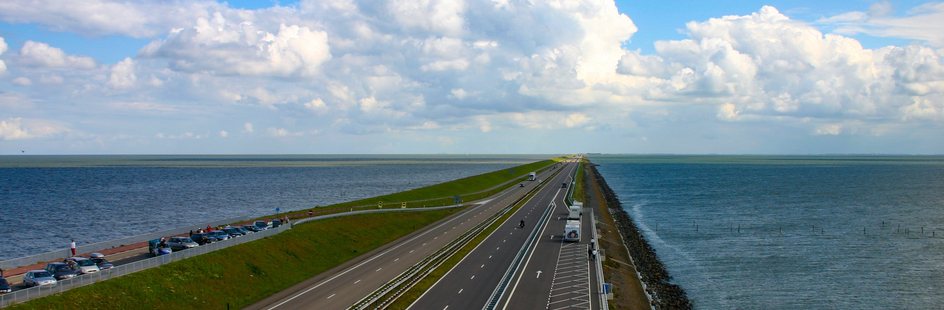
Whenever I drive across the Afsluitdijk, looking out over the Wadden Sea on one side and the IJsselmeer on the other, I am struck by the massive scale of our water management. While humans can easily drive from one side to the other, many fish species find their migration routes blocked. We take pride in our ability to control water, but what does this look like from a fish' perspective? Dams, sluices, and weirs, together with increasing temperatures and invasive species, have pushed our freshwater fishes and the ecosystems they live in to a breaking point. It is a challenge that demands our attention, as the health of freshwater ecosystems are fundamental to our recreation, our drinking water, and the food on our dinner plates.
IUCN sounds the alarm
The International Union for Conservation (IUCN) categorises species, among which European freshwater fishes, based on how well they are doing in the wild. The seven categories (from “Extinct” to “Least Concern”) identify the extinction risk of species based on a number of relevant threats. In simple terms, the list acts as a health check for our species. Currently, almost half (40%) of freshwater fish species in Europe are threatened with extinction. The restructuring of free-flowing rivers, climate change and the introduction of foreign species are at the top of the list of threats. For anyone who values the health of our rivers, these numbers represent a serious cause for concern.
Blocked highways
But not all fish species face the same challenges. The problem lies in our restructuring of free-flowing rivers, especially for migrating fish species. For them, rivers function as highways, that are currently covered in roadblocks. European eel, for example, spawn in the Sargasso Sea near the east coast of North America. From there, they navigate thousands of kilometres to European rivers to grow. The first part of their journey, crossing the Atlantic Ocean to Europe, is relatively smooth sailing. The final stretch is where the problems begin.
In Europe, barriers such as dams, sluices and weirs affect half of the total river length. In the Netherlands the number of barriers is nearly 20 per kilometre. Massive structures like the Afsluitdijk, Haringvlietsluis, Volkeraksluis, and the North Sea canal are not just our famous engineering achievements, they are like landslides that block the road to vital feeding and breeding grounds for fish. This makes migration increasingly challenging for species such as the European eel, that are currently “Critically Endangered”.
Trapped in a changing environment
On the other hand, some species do not undertake long distance migrations. Instead, they spend their entire life in the same lake or river. Less visible threats such as climate change and invasive species pose a risk to these less mobile species. As they are restricted to one water body, they cannot escape changes in their environment. As temperatures rise, periods with high amounts of (toxic) algae increase. When the algae die, the decay takes the oxygen out of the water, suffocating fish. While warm-water species such as carp can often endure such harsh conditions, species built for flowing, oxygen rich waters, like salmon, will die.
Furthermore, while marine fish species can move to cooler regions in response to ocean warming, freshwater fish are often trapped in European rivers blocked by dams. Climate change effects are therefore a major contributor to their threatened conservation status. Atlantic salmon, for example, are classified as “Endangered”, and their populations are still declining.
Opening the floodgates
But what happens when we do connect different waters? As it turns out, creating new connections can also be problematic. New artificial waterways, such as the Danube-Rhine canal, connect formerly isolated regions and allow species to expand or change their habitat range. These human-made canals in combination with intensive transport serve as highways for the invasion of new species. These newly introduced species have a negative effect on the native inhabitants. They can predate on native fish, or fight them for food and space.
The round goby is a particularly well-studied example of a species invading native Dutch fish communities. While this species from the Black Sea and Caspian Sea is rather small and ordinary-looking, they outcompete native species for food and space. Since the introduction of the round goby in the Netherlands, native bullhead populations have been decreasing drastically and are classed as “Vulnerable”. The bottom-dwelling bullhead relies on small spaces under rocks to hide from predators and lay their eggs. However, the round goby is faster and more territorial, it thus occupies these hiding spots before the bullheads, leaving them exposed to predators, like perch and pikeperch.
Turning the tide
While there are signs of progress, the current efforts are only the beginning of a long journey. The European Commission aims to restore the free flow of 25,000 km of river in Europe by 2030. In the Netherlands, we see this through the partial opening of the Haringvlietsluis to improve the connection between the North Sea, and the Rhine and Meuse estuaries. Besides these large-scale interventions, smaller projects are being undertaken throughout Europe, such as the removal or redesign of smaller weirs and dams to reconnect fragmented river networks.
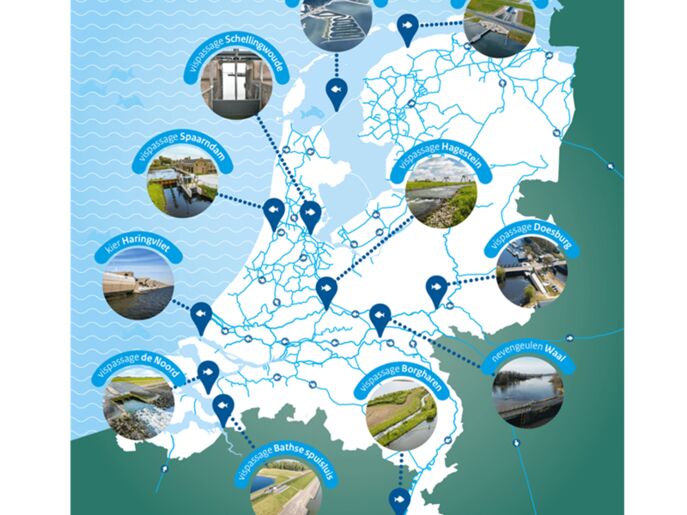
In the Netherlands, organisations such as Rijkswaterstaat and Waterschappen are working on the construction of fish passages around remaining obstacles, creating safe routes for fish to navigate (see figure). Climate change and invasive species are more complex problems to solve. However, the restoration of degraded habitat, such as the construction of Marker Wadden in the Markermeer, show promising results. The Ballast Water Management convention aims to reduce the spread of invasive species throughout Europe by requiring international traffic to filter their ballast water.
These are important steps, but we certainly are not there yet. To truly save the fish that feed us and sustain our environment, we need to rethink how we manage our waters. The tide is turning, but only through urgent, continued action can we ensure that there are still fish in our rivers, and keep our freshwater ecosystems healthy to provide our recreation, drinking water and the food on our dinner plates for generations to come.
This article was written by Kyra Beeftink
If you want to read more articles like this, please check out the overview page.
Sources
Belletti, B., Garcia de Leaniz, C., Jones, J., Bizzi, S., Börger, L., Segura, G., Castelletti, A., van de Bund, W., Aarestrup, K., Barry, J., Belka, K., Berkhuysen, A., Birnie-Gauvin, K., Bussettini, M., Carolli, M., Consuegra, S., Dopico, E., Feierfeil, T., Fernández, S., … Zalewski, M. (2020). More than one million barriers fragment Europe’s rivers. Nature, 588(7838), 436–441. https://doi.org/10.1038/s41586-020-3005-2
Costa, M. J., Duarte, G., Segurado, P., & Branco, P. (2021). Major threats to European freshwater fish species. Science of The Total https://doi.org/10.1016/j.scitotenv.2021.149105
De Leeuw, J. J., Volwater, J. J. J., Van Keeken, O. A., Van Emmerik, W. A. M., & Van Leeuwen, C. H. A. (2024). Creating wetland islands to enhance shoreline habitat for fish recruitment in a modified shallow lake. Aquatic Conservation: Marine and Freshwater Ecosystems, 34(1), e4052. https://doi.org/10.1002/aqc.4052
European Commission. (2021). Barrier removal for river restoration: Guidance for the EU biodiversity strategy for 2030. Publications Office of the European Union.
International Convention for the Control and Management of Ships’ Ballast Water and Sediments (BWM). (n.d.). https://www.imo.org/en/about/conventions/pages/international-convention-for-the-control-and-management-of-ships%27-ballast-water-and-sediments-(bwm).aspx
IUCN. 2025. The IUCN Red List of Threatened Species. Version 2025-2. https://www.iucnredlist.org.
Kessel, N. V., Dorenbosch, M., Kranenbarg, J., van der Velde, G., & Leuven, R. S. (2016). Invasive Ponto-Caspian gobies rapidly reduce the abundance of protected native bullhead
Kranenbarg, J. & F. Spikmans. 2013. Achtergronddocument Rode Lijst Vissen 2011. Zoetwatervissen. Stichting RAVON, Nijmegen
Ministerie van Infrastructuur en Waterstaat. (2025, 8 December). Ruim baan voor vis. https://www.rijkswaterstaat.nl/water/waterbeheer/waterkwaliteit/maatregelen-waterkwaliteit/ruim-baan-voor-vis
Pike, C., Crook, V., Gollock, M., Beaulaton, L., Belpaire, C., Dekker, W., Diaz, E., Durif, C. M. F., & Hanel, R. (2020). Anguilla anguilla, European eel (No. hal-04461073). The IUCN Red List of Threatened SpeciesTM. https://hal.science/hal-04461073v1