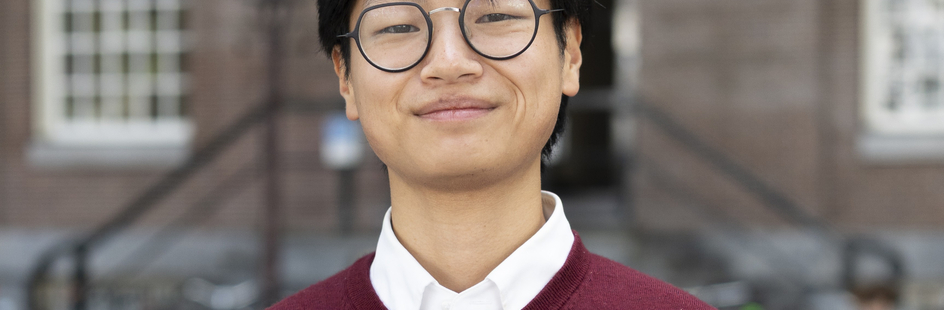
Five questions for student assessor Henry de Vries
Five questions for student assessor Henry de Vries
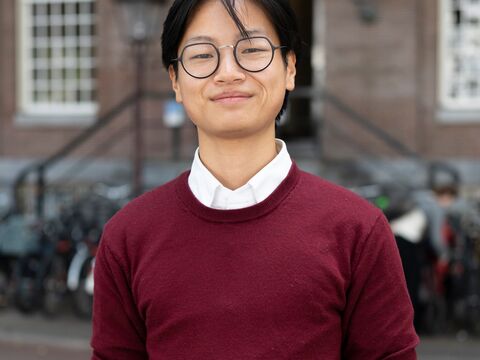
Who is Henry de Vries?
I am a Master’s student in Mathematics. I completed my Bachelor’s degree in Leiden and am now in the second year of my Master’s at the UvA. Alongside my studies, I do lots of different things. I have always drawn a lot and recently started painting as well. I am hugely interested in modern art and regularly visit the Stedelijk Museum Amsterdam.
Besides mathematics, it is important to me to express myself creatively in other ways. Mathematics is creative too, but in a very different way from, for example, painting or cooking. I really enjoy that variety.
I also enjoy climbing. I do bouldering and top-rope climbing. A climbing route is essentially a kind of puzzle that you have to solve, which is what I find so enjoyable about it.
Why are you a good student assessor for the UvA?
Initially, I applied to join the Faculty Student Council of the Faculty of Science, but then I saw the vacancy for student assessor. I thought: actually, this suits me better.
In Leiden, I had already gained experience in student participation. I represented student assistants on a council that advised the board of the Mathematical Institute. That taught me how to engage with administrators, try to understand their interests, and at the same time stand up for the people you represent.
I do not find it difficult to ask questions, and I do not take many things that happen within a university for granted. I then think: why do we actually do things this way? That curiosity is also strongly reflected in my degree programme. As a mathematician, you constantly learn to ask questions and test assumptions. I think that can be very useful at administrative level too.
‘As a mathematician, you constantly learn to ask questions and test assumptions. I think that can be very useful at administrative level too.’
"‘As a mathematician, you constantly learn to ask questions and test assumptions. I think that can be very useful at administrative level too.’"
What issue would you like to put on the Executive Board’s agenda?
I would very much like to keep the conversation about generative AI active. We are faced with a fundamental question: the university needs to justify why it still exists. That is quite a daunting and difficult issue, but it is a genuine question.
Students come to university to receive an academic education. But if many of the things you learn can increasingly be done more easily by AI, students are right to wonder what will be left for them in the labour market.
I think administrators are certainly aware of this, but that it can sometimes remain rather abstract. Our core business is education. That is why we need to keep examining whether our education is still appropriate and responds to the challenges students face. I can discuss these kinds of issues directly with the Executive Board.
In your view, what value does a university still have?
I think the university has enormous value, but that we sometimes do a poor job of explaining exactly what that value is. Students may come to see university as a means to an end: you obtain your degree and then move on.
But a university is much more than your specific degree programme. You become part of a community and an intellectual network. You meet people with different perspectives and are given the space to try new things. These are all things that make a university a university.
Now that technology is changing education so profoundly, I think it is important that we reflect on this together. The UvA also has something distinctive to offer in this respect. We are not a technical university, but we have a great deal of technical expertise as well as strong humanities and social sciences. This means that we can look not only at what technology can do, but also at its consequences for people and society.
I would like to see us bring these different perspectives together much more and jointly develop a vision for how we want to engage with technology and AI.
How do you make sure you know what is on students’ minds?
I can be found at different campuses throughout the week. I want to be present at as many activities as possible and stay in contact with study and student associations. In this way, I hope to keep talking to a wide range of student groups.
I am always reachable by email, and I also want to continue the existing drop-in hour [HV4.1]. This takes place every Thursday between 10.30 and 11.30. I think it is important that students can simply come and talk to me.
Finally, above all, I want students to feel that there is space for them to come up with ideas themselves. The university is a place where you can learn a great deal and are given many opportunities to try things out. I would like students to make use of that. You should be able to suddenly think: I want to do this